

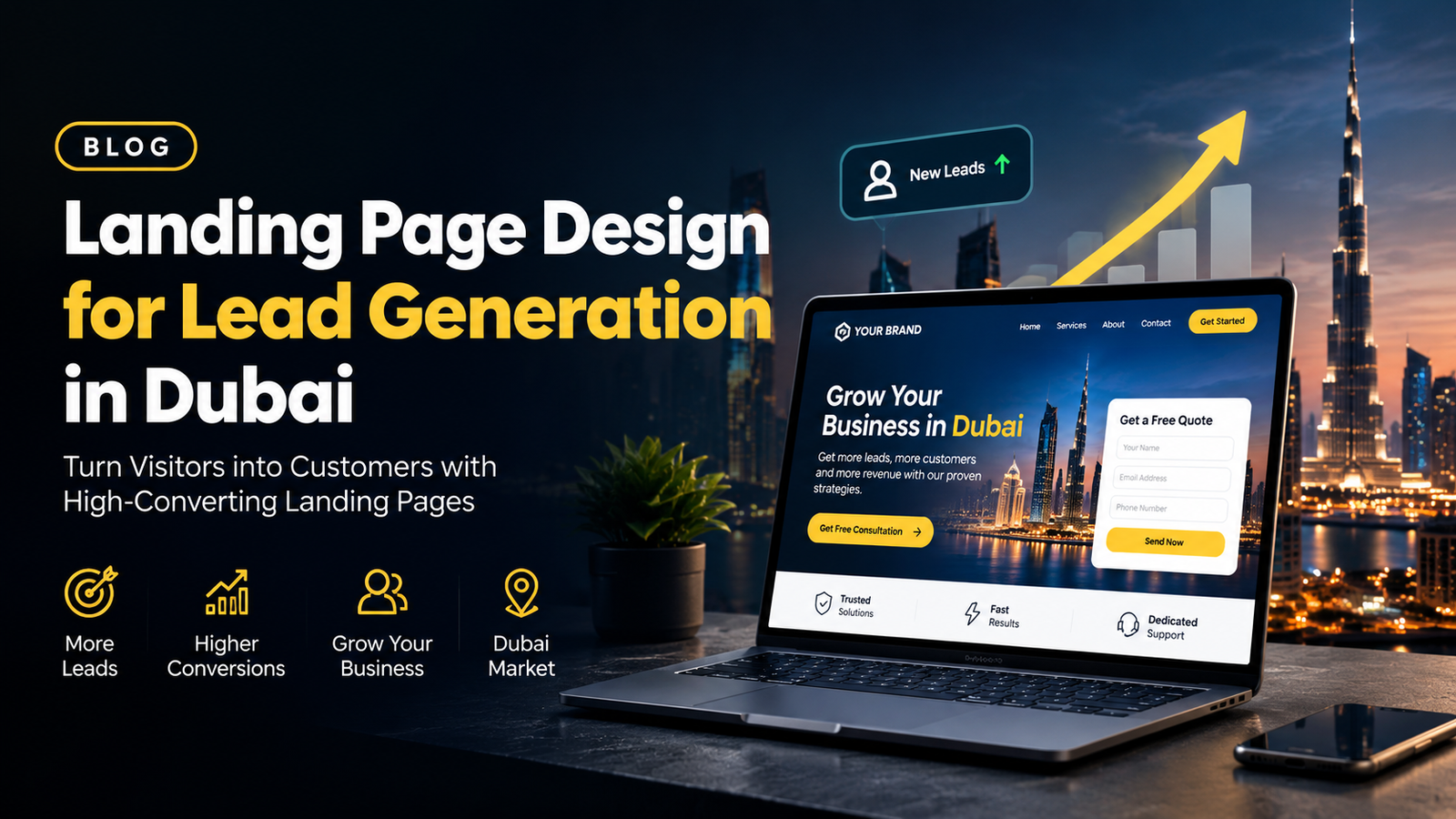
Businesses in Dubai operate in a competitive digital market where attracting website visitors is only the first step toward winning new customers. Whether you offer professional services, real estate solutions, digital marketing, consultancy, or other business services, your website needs to do more than look attractive. It should encourage visitors to take action.
This is where landing page design for lead generation in Dubai becomes important. A well-designed landing page helps businesses turn advertising clicks and website visits into meaningful enquiries, consultation requests, quote requests, and potential sales.
Unlike a traditional website page that may contain several navigation options and competing messages, a landing page focuses on a specific audience and one primary conversion goal. It combines persuasive copywriting, user-friendly design, relevant information, and clear calls to action to guide visitors toward the next step.
In this guide, we will explore how landing pages work, which elements improve conversions, how Dubai businesses can approach landing page design, and what to consider when choosing a professional landing page design service.
What Is Landing Page Design for Lead Generation?
Landing page design is the process of creating a dedicated web page that encourages visitors to complete a particular action. That action might include submitting a contact form, requesting a quotation, booking a consultation, or registering for a service.
Lead generation focuses on attracting people who may be interested in a business’s products or services and collecting their details with appropriate consent so the business can follow up.
For example, a digital marketing agency in Dubai could run a Google Ads campaign targeting businesses looking for SEO services. Instead of sending every visitor to the homepage, the agency could direct them to a dedicated landing page explaining its SEO services, outlining its approach, and offering a consultation.
This approach connects the advertisement with a relevant page and makes the next step clearer.
A landing page designed for lead generation typically includes:
- A clear headline explaining the main benefit.
- A concise description of the service or offer.
- Supporting information that builds trust.
- A visible call-to-action button.
- A simple enquiry form.
- Relevant testimonials or evidence, where available.
- A mobile-friendly layout and fast loading experience.
The objective is not simply to attract more traffic. It is to make it easier for suitable visitors to become potential customers.
Why Dubai Businesses Need High-Converting Landing Pages
Dubai has businesses serving local residents, international customers, tourists, investors, and companies across multiple industries. This creates opportunities, but it also means that businesses often compete for the same audience online.
A dedicated landing page can help a business communicate its value more effectively and make its marketing campaigns more focused.
1. Turn advertising clicks into business enquiries
Businesses investing in Google Ads, social media advertising, or other paid campaigns need relevant destinations for their traffic.
If someone clicks an advertisement for website design services but lands on a general homepage with information about unrelated services, the visitor may struggle to find what they need.
A dedicated landing page can continue the same message from the advertisement, explain the service, and provide a straightforward way to enquire.
2. Communicate your value proposition clearly
Potential customers need to understand why they should consider your business.
A strong landing page answers three questions quickly:
- What service do you provide?
- Who is it for?
- What should the visitor do next?
For example, a business offering corporate photography in Dubai could highlight its services for company profiles, professional headshots, and commercial campaigns rather than using a vague headline such as “Welcome to Our Website.”
Specific messaging helps visitors understand whether the offer matches their needs.
3. Build trust with potential customers
People may hesitate to submit their contact details when they do not know a business.
Landing pages can address this concern through genuine customer testimonials, relevant case studies, transparent service information, business contact details, and examples of previous work.
Only publish testimonials, client logos, certifications, or performance figures that you can substantiate. Trust is stronger when claims are specific and credible.
4. Improve the performance of marketing campaigns
A dedicated landing page makes it easier to measure how visitors respond to a particular campaign.
Businesses can track visits, form submissions, phone enquiries, and other meaningful actions. This information helps marketers identify which campaigns generate useful leads and where visitors encounter problems.
A landing page does not automatically make advertising more profitable, but it provides a focused destination that can be tested and improved over time.
Essential Elements of a High-Converting Landing Page

Effective landing page design combines visual presentation with usability, persuasive content, and measurement. The following elements are important when building a page for lead generation in Dubai.
1. A compelling headline
The headline is often the first substantial piece of information a visitor reads. It should communicate the main offer without forcing visitors to interpret vague marketing language.
For example, a landing page for a web design company might use:
Professional Website Design for Growing Businesses in Dubai
A supporting sentence could explain that the company builds mobile-friendly business websites designed to present services clearly and encourage customer enquiries.
The headline should match the advertisement, keyword, or link that brought the visitor to the page. Avoid promising guaranteed rankings, sales, or results that you cannot substantiate.
2. Clear and persuasive website copy
Visitors should be able to understand your offer without reading unnecessary paragraphs.
Explain the problem your service addresses, how your process works, what the customer can expect, and how to get started.
Use short paragraphs, descriptive subheadings, and bullet points to make the page easier to scan. Focus on benefits while including enough detail to answer the questions a potential customer is likely to have.
For business audiences in Dubai, the appropriate tone will depend on the target market. A professional services firm may need a more formal presentation, while a consumer-focused brand may benefit from a more conversational style.
3. A visible call to action
A call to action (CTA) tells visitors what to do next.
Examples include:
- Request a Free Consultation
- Get a Project Quote
- Book a Discovery Call
- Discuss Your Project
Choose a CTA that accurately reflects what your business offers. If a consultation is not free, do not describe it as free.
Place the primary CTA where visitors can easily find it, such as near the opening headline, after important service information, and near the end of the page. On mobile devices, make sure buttons are easy to tap.
4. A simple enquiry form
A contact form should collect enough information to respond effectively without creating unnecessary friction.
For an initial enquiry, useful fields might include:
- Name
- Business email or preferred contact method
- Company name, if relevant
- Service required
- A short description of the project
Not every business needs all these fields. A short form may work better for a simple consultation request, while a complex B2B service may require additional qualification questions.
Explain how submitted information will be used, provide an appropriate privacy notice, and obtain any consent required for marketing communications.
5. Trust signals and supporting evidence
Trust signals help visitors evaluate whether your business is credible.
Depending on your services, these may include genuine client reviews, portfolio examples, transparent processes, relevant experience, verified certifications, and case studies.
If you publish a case study, describe the original challenge, the work performed, and the results you can substantiate. Avoid inventing client outcomes or presenting hypothetical examples as completed projects.
For a newer business without extensive testimonials, a clear explanation of your process, examples of your work, and accessible contact information can still help establish credibility.
6. Mobile-responsive design
Many potential customers browse websites on smartphones. A landing page should remain easy to use across different screen sizes.
Use readable font sizes, sufficient spacing, responsive images, and buttons that are easy to tap. Keep important information near the top and avoid intrusive pop-ups that make the page difficult to use.
Test the entire enquiry process on a real mobile device, including form completion and confirmation messages.
7. Fast loading speed
Slow pages can frustrate visitors and interfere with the user experience.
To improve performance, compress images, avoid unnecessary animations, limit heavy third-party scripts, and use appropriate caching. A content delivery network may also help serve assets efficiently to visitors in different locations.
Test your page with Google Page Speed Insights and review both mobile and desktop recommendations. Aim for a good user experience rather than relying on one speed score alone.
How to Design a Landing Page for Lead Generation in Dubai
Creating an effective landing page starts with a clear plan. The following process can help businesses and marketing teams build a page around customer needs rather than design trends alone.
Step 1: Define your target audience
Before choosing colours, images, or layouts, identify the people you want to attract.
For example, a Dubai-based accounting consultancy may target small business owners seeking bookkeeping support, VAT-related assistance, or financial reporting services.
Each audience has different questions, concerns, and expectations. Understanding these differences helps you choose the right message and call to action.
Consider the customer’s industry, location, business size, main challenge, and likely reasons for contacting you.
Step 2: Choose one primary conversion goal
A landing page should have a clear primary objective.
You might want visitors to request a quotation, schedule a consultation, submit a project brief, or register for an event.
Several unrelated calls to action can distract visitors. Supporting links may still be useful, but the page should make its main next step obvious.
Step 3: Match the page to the traffic source
The landing page should reflect the visitor’s expectations.
If your Google Ads campaign promotes social media management, the destination should explain that service rather than focusing mainly on web development.
Similarly, an article about SEO should direct interested readers to a relevant SEO service page or consultation offer.
Consistent messaging helps visitors understand that they have reached the right place.
Step 4: Create a clear visual hierarchy
Visual hierarchy determines which information visitors notice first.
A practical structure often includes a headline and CTA, a short explanation of the offer, supporting benefits, evidence that builds trust, an explanation of the process, answers to common questions, and a final CTA.
Use headings, spacing, and contrasting button styles to make the content easier to navigate. Avoid adding decorative elements that compete with the main message.
Step 5: Write copy that addresses customer concerns
Potential customers may want to know about pricing, delivery times, what is included, how communication works, or whether the service suits their business.
Answer the most important questions directly. Where pricing varies, explain the factors that influence cost rather than publishing misleading starting prices.
Useful, specific information can help visitors decide whether to enquire and can reduce unsuitable leads.
Step 6: Implement analytics and conversion tracking
Before launching the page, decide how you will measure success.
Useful measurements include:
- Landing page visits.
- Enquiry form submissions.
- Clicks on telephone or email links.
- Consultation bookings.
- Qualified leads.
- Leads that eventually become customers.
Configure analytics and conversion tracking appropriately, respecting applicable privacy requirements. Test your tracking to ensure that actions are recorded correctly and that duplicate conversions are avoided.
Step 7: Test and improve the page
A landing page should not be treated as a finished product that never changes.
Review visitor behaviour and enquiry quality to identify opportunities for improvement. You might test a more specific headline, a shorter form, a different CTA, or clearer service information.
Change one important element at a time where practical, and evaluate results using enough data to make a reasonable comparison. Small or inconclusive samples should not be treated as proof that one version is better.
Landing Page SEO: How to Attract Relevant Visitors from Google
Landing page design for lead generation and search engine optimization can support one another, but they serve different purposes.
Conversion optimization focuses on helping visitors take action. SEO helps relevant pages become discoverable through organic search.
For a business targeting Dubai, consider the following practices.
Target relevant keywords naturally
Choose search terms that match your service and the intent of your audience.
Examples include:
- Landing page design for lead generation Dubai
- Landing page design services Dubai
- Landing page development Dubai
- Lead generation website design Dubai
- Conversion-focused web design Dubai
Use the primary keyword in the title and page content where it reads naturally. Include related phrases only when they accurately describe the service.
Do not repeat the same keyword excessively or create multiple nearly identical pages simply to target small variations of a phrase.
Optimize the title, meta description, and URL
Write a descriptive page title that clearly communicates the service. Create a concise meta description that explains the value of the page and encourages relevant visitors to click.
Use a short, readable URL that reflects the page topic. A meta description can help communicate relevance in search results, but Google may choose a different snippet, and neither a title nor a description guarantees rankings.
Provide useful, original content
Explain the service, the process, what is included, and how businesses can evaluate their options. Add original examples, genuine portfolio work, or practical insights that help readers make a decision.
Do not expand an article with repetitive paragraphs merely to reach a target word count. The right amount of content depends on what visitors need to understand the offer.
Improve internal linking
Link relevant blog articles to the appropriate service pages using descriptive anchor text.
For example, a blog post explaining lead generation could link to a landing page design service page. A related article about Google Ads could link to a page discussing campaign landing pages.
Internal links help readers explore related services and help search engines understand how your pages relate to one another.
Measure organic performance
Use Google Search Console to monitor impressions, clicks, search queries, and page performance. Review Google Analytics or another suitable analytics tool to understand engagement and completed enquiries.
These measurements help you distinguish between a page that attracts visitors and a page that contributes to your business goals.
How Much Does Landing Page Design Cost in Dubai?
The cost of landing page design in Dubai varies according to the project’s complexity, the designer’s experience, the content required, and the functionality involved.
A straightforward landing page with an existing brand identity and supplied content will generally require less work than a custom page involving extensive research, original copywriting, bespoke design, integrations, and analytics configuration.
Factors that may influence the price include:
- Custom design versus a pre-built template.
- Copywriting and keyword research.
- Mobile-responsive development.
- Number and complexity of forms.
- CRM or marketing automation integration.
- Analytics and conversion tracking.
- Testing, revisions, and ongoing maintenance.
When comparing proposals, look beyond the headline price. Ask what is included, who supplies the content, how many revisions are allowed, whether tracking is configured, and who will maintain the page after launch.
The cheapest option is not always the best value, but an expensive design is not automatically more effective either. Choose a solution that fits your goals, budget, and operational requirements.
Common Landing Page Design Mistakes to Avoid
Even a visually attractive page may struggle to generate enquiries if important usability and messaging issues remain.
Using a vague headline: Visitors should quickly understand the offer and who it is for.
Adding too many competing calls to action: Give visitors one clear primary next step.
Making forms unnecessarily complicated: Request only the information needed at that stage of the customer journey.
Ignoring mobile users: Check layouts, button sizes, text readability, and forms on different screen sizes.
Making unsupported claims: Use accurate service descriptions, genuine testimonials, and verifiable results.
Ignoring page speed: Optimize images and scripts and test the page before launch.
Failing to measure leads: Track meaningful actions and assess lead quality, not just visits and clicks.
Sending every visitor to the same page: Where campaigns target substantially different services or audiences, consider whether separate, relevant landing pages would serve those visitors better.
How to Choose a Landing Page Design Agency in Dubai
Selecting a suitable agency involves more than comparing design portfolios.
Start by reviewing examples of previous work. Look for pages that communicate the offer clearly, work well on mobile devices, and make it easy for visitors to take action.
Ask about the agency’s approach to audience research, copywriting, responsive development, SEO, analytics, and conversion tracking. Clarify which deliverables are included in the proposal and who owns the website files, domain-related assets, and advertising data.
You should also understand how performance will be evaluated after launch. A professional provider should be able to explain its process, identify realistic goals, and distinguish between improvements it can control and outcomes that depend on factors such as traffic quality, pricing, competition, and the offer itself.
For businesses looking for landing page design in Dubai, the best partner is one that understands the commercial objective behind the page—not simply how to make it look attractive.
Frequently Asked Questions
1. What is a landing page used for in lead generation?
A landing page is designed to encourage a visitor to complete a specific action, such as submitting an enquiry, requesting a quote, or booking a consultation. It supports lead generation by presenting a relevant offer and making the next step clear.
2. Why do businesses in Dubai need a dedicated landing page?
A dedicated landing page can help Dubai businesses align their advertising with a specific service, communicate their value proposition, build trust, and make enquiries easier. Its effectiveness depends on the relevance of the offer, the quality of traffic, and the user experience.
3. What should a lead generation landing page include?
Most lead generation landing pages benefit from a clear headline, concise service information, a visible CTA, a suitable enquiry form, trust-building evidence, mobile-friendly design, and reliable conversion tracking. The exact structure depends on the business and its audience.
4. Is landing page SEO different from regular website SEO?
The underlying SEO principles are similar, but a landing page usually has a more focused purpose. It should target relevant search intent, load efficiently, provide useful content, and make the desired action clear. Not every landing page needs to target organic search; some are created primarily for paid advertising.
5. How can I improve my landing page conversion rate?
Start by measuring the current conversion rate and checking whether visitors match your target audience. Then review the headline, offer, CTA, form length, mobile experience, loading speed, and trust signals. Test meaningful changes and evaluate both conversion quantity and lead quality.
6. Should I use one landing page for all my marketing campaigns?
Not necessarily. A single page may work when campaigns promote the same service to a similar audience. Separate pages can be more useful when different campaigns have distinct offers, audiences, or search intent. Each page should provide genuinely relevant information rather than simply swapping keywords.
Conclusion: Turn More Relevant Visitors into Potential Customers
Landing page design for lead generation in Dubai is about combining clear messaging, useful information, persuasive design, and a straightforward conversion process. For businesses investing in digital marketing, a well-planned landing page can provide a more relevant experience for potential customers and make campaign performance easier to measure.
Start by identifying your target audience, choosing one primary conversion goal, and creating a page that addresses customer questions without unnecessary distractions. Make sure the design works well on mobile devices, implement reliable tracking, and use real performance data to guide improvements.
If your business needs a landing page that supports its lead generation and digital marketing goals, Zorax Media can be positioned as a partner for discussing your website requirements, campaign objectives, and potential design approach.
Ready to improve your online lead generation? Contact Zorax Media to discuss your landing page design requirements and explore a solution tailored to your business goals.
